Best Practices in Data Collection and Preparation


Very, very helpful article on best practices of handling research data and writing transparent and well documented research.

The authors focus on
(a) type of research design
(b) control variables
(c) sampling procedures, and
(d) missing data management
(e) outlier management
(f) use of corrections for statistical and methodological artifacts
(g) data transformations

Instead of classical textbook approach, this article gives you a very clear hands-on perspective, with a good portion of examples and references.

Definitely worth a read if you do either quantitative or qualitative empirical research!

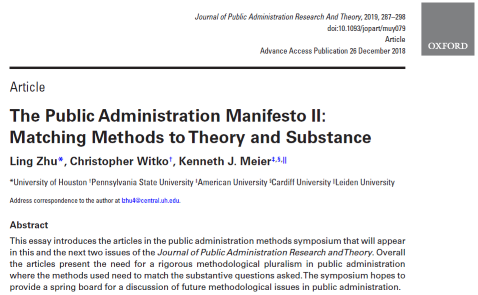
The Public Administration Manifesto II

Ling Zhu, Christopher Witko, Kenneth J Meier, The Public Administration Manifesto II: Matching Methods to Theory and Substance, Journal of Public Administration Research and Theory, Volume 29, Issue 2, April 2019, Pages 287–298, https://doi.org/10.1093/jopart/muy079


I read this article with anticipation and was not let down. The paper is the result of a “methods symposium” “that will appear in this and the next two issues of the
Journal of Public Administration Research and Theory”. It links the
articles in this symposium together into a combination of a descriptive
“state of the art” and a normative impetus on forking out a path
forward. “

The article gave me the “big picture” on use of methods in PA-research – and I will surely return to it as a guide showing me where to go for digging further into methodological questions. If you want a up-to-date vitamin-injection concerning methodological challenges in PA research: look no further.

Four conclusions:
1 Self-reflective use of methods is essential.
2 Methodological pluralism is necessary – challenging the division of
qualitative and quantitative approaches
3 Generalizability and replicability are real and vital challenges
4 PA needs a stronger arena for “methodological debates regarding best
practices and sophisticated methods in different substantive research
areas.”

I will hunt down the main articles referred to in this article, and they will appear in this space in the coming months.


Reporting well when using PLS-SEM

Article: Joseph F., Jr, Hair, & Risher, Jeff & Sarstedt, Marko & Ringle, Christian. (2018). When to use and how to report the results of PLS-SEM. European Business Review. 31. 10.1108/EBR-11-2018-0203.
Link: https://www.emeraldinsight.com/doi/abs/10.1108/EBR-11-2018-0203

SEM-analysis, Structural Equation Modelling, is described as a second-generation technique within multivariate methods (Hair et al. 2017). First-generation methods comprise of exploratory methods like cluster analysis, exploratory factor analysis and multidimensional scaling, and confirmatory methods like analysis of variance, logistic regression, multiple regression, and confirmatory factor analysis. Second generation techniques go further in statistical strength and flexibility with the use of Partial Least Squares Structural Equation Modelling (PLS-SEM) as an exploratory tool and Covariance-Based Structural Equation Modelling (CB-SEM) as a confirmatory tool.

Hair (2017) describes some of the benefits of using SEM-analysis approach as

  • the ability to use composite variables (often called variates),
  • the ability to use unobservable (latent) variables – through indicator variables
  • the ability to account for measurement error in observed variables
  • simultaneously examine relationships among measured variables and latent variables.

SEM-analysis is used as a powerful predictive statistical approach – the analysis of the sample giving predictability to the population.

This article shows the most recent update on how to report the results when using PLS-SEM. I use SMART-PLS 3 as my preferred program for doing PLS-SEM analysis, and it gives me a lot of the data which Hair et.al proscribes in this article. Older articles do not neccesarily live up to the most recent standards of reporting – therefore this article is a good help to reporting well.