Milestone: paper accepted for publishing!

Very happy that an article I have co-authored together with Åge Johnsen, Jan-Erik Johanson and Elias Pekkola has been accepted for publication in the journal “Administrative Science”: https://www.researchgate.net/publication/336141649_Strategic_Management_in_Finnish_and_Norwegian_Government_Agencies

I put a lot of work into gathering data for the part of this article detailing strategic management in Norwegian government agencies and have learned a lot from collaborating with brilliant scholars.

Abstract:
The purpose of this article is to analyse the design and implementation of strategic planning and performance management in governmental agencies in two Nordic countries, Finland and Norway. The Nordic countries are an interesting study from a comparative perspective because while they are commonly assumed to have been high-intensity new public management reformers, they are commonly assumed also to have a distinct public management tradition. Moreover, these two countries are interesting to study because within the Nordic public management tradition, Finland and Norway represent two different public management traditions. Finland belongs to the Eastern Nordic public management tradition, with an emphasis on decentralisation and agency autonomy, while Norway belongs to the Western Nordic public management tradition, with an emphasis on hierarchical governance and hence much performance management and reporting. Therefore, we expected to find more decentralised strategic management and emphasis on evaluation in Finland and more central, planning-like strategic management and reporting in Norway. Our comparison shows that both countries had mandatory strategic planning and utilised decentralised strategic planning in government agencies. The stronger legal orientation in the public administration in Finland, however, made strategic changes more complicated in Finland than in Norway.

Lost in translation?

Ongaro, Edoardo and van Thiel, Sandra. “Languages and Public Administration in Europe” In The Palgrave Handbook of Public Administration in Europe, edited by Edoardo Ongaro and Sandra van Thiel, 61-98. London: Palgrave Macmillan, 2018

“The single biggest problem in communication is the illusion that it has taken place ” George Bernard Shaw.

Ongaro and van Thiel’s article in The Palgrave Handbook of Public
Administration in Europe
raises the question whether we understand eachother
when we use the same key concepts in the study of public administration.

The first section outlines the idea behind the article. Even if English is a lingua franca in academia, the various authors’ culture and linguistic background may influence
their perception of concepts.
Then Ongaro and van Thiel lets a number of scholars in the field reflect on how
the following concepts can be understood/interpreted in the various languages in Europe:
accountability, agency/agencification, governance, leadership, management/
public management, public administration, performance, policy, public values,
security. In addition they reflect on central concepts in their
respective languages that do not communicate well into English.

The result is a very instructive demonstration that the core concepts of public administration, have a lot of different challenges in being translated into various languages – a fact which poses a challenge to for instance teaching public administration in the vernacular languages. Trying to stick to your mother tongue might be difficult when communicating insights from the international academic arena.

English is a dominant language in the international academic sphere. I believe precise communication across cultural and linguistic borders is attainable, however –
there might be an interesting richness of diverse meanings which are more or
less hidden behind the use of the same English key concepts.

The article gives insight into how not only obscure phrases, but also key concepts might create communication challenges for academics originating in different countries and cultures. Next time I read an article or speak with a colleague from another country – I might just be haunted by the question: are we speaking about the same thing even if we are using the same concepts? Hopefully – that will lead to interesting clarifications and new insights. 


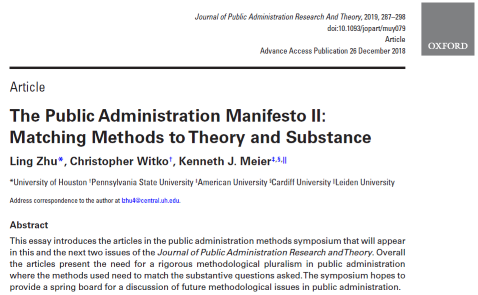
The Public Administration Manifesto II

Ling Zhu, Christopher Witko, Kenneth J Meier, The Public Administration Manifesto II: Matching Methods to Theory and Substance, Journal of Public Administration Research and Theory, Volume 29, Issue 2, April 2019, Pages 287–298, https://doi.org/10.1093/jopart/muy079


I read this article with anticipation and was not let down. The paper is the result of a “methods symposium” “that will appear in this and the next two issues of the
Journal of Public Administration Research and Theory”. It links the
articles in this symposium together into a combination of a descriptive
“state of the art” and a normative impetus on forking out a path
forward. “

The article gave me the “big picture” on use of methods in PA-research – and I will surely return to it as a guide showing me where to go for digging further into methodological questions. If you want a up-to-date vitamin-injection concerning methodological challenges in PA research: look no further.

Four conclusions:
1 Self-reflective use of methods is essential.
2 Methodological pluralism is necessary – challenging the division of
qualitative and quantitative approaches
3 Generalizability and replicability are real and vital challenges
4 PA needs a stronger arena for “methodological debates regarding best
practices and sophisticated methods in different substantive research
areas.”

I will hunt down the main articles referred to in this article, and they will appear in this space in the coming months.