Article: Dijkstra, Theo & Henseler, Jörg. (2015). Consistent Partial Least Squares Path Modeling. MIS Quarterly. 39. 10.25300/MISQ/2015/39.2.02.
link: https://misq.org/catalog/product/view/id/1701
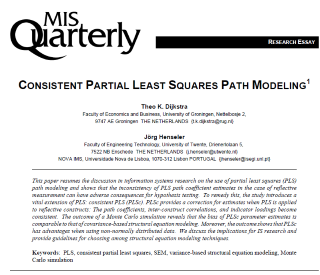
The PLS-SEM tool got a valuable update/option with “Consistent PLS-SEM” = PLSc. No single approach is “the one and only” tool. The article explains when you should know about some of the shortcomings of classical PLS-SEM, and demonstrates some of the advantages to the updated PLS algorith called “PLSc”. Especially “PLSc provides a correction for estimates when PLS is applied to reflective constructs: The path coefficients, inter-construct correlations, and indicator loadings become consistent” (Dijkstra et al. 2015).
I found the article to be both important and clear – supplying good reason to be aware of which situations classical PLS-SEM has shortcomings. The program SMART-PLS lets you run the same data with either the classical allgorithm or the newer PLSc – but you should know why you choose either or. This article helps you know.
I ran my data with both classical PLS-SEM and PLSc. The difference in results were noteworthy, both in the structural model and the measurement model. I both had data with non-normal distribution and I used reflective measurement models – so PLSc seemed to be the best choice of the two.
The worst of the math is put in the appendix – leaving the article itself unriddled.
More related to this: Another article by the same author deals with PLSc in nonlinear SEM’s: Dijkstra, T. K., & Schermelleh-engel, K. (2014). Consistent partial least squares for nonlinear structural equation models. Psychometrika, 79(4), 585-604. doi:http://dx.doi.org.ezproxy.hioa.no/10.1007/s11336-013-9370-0

